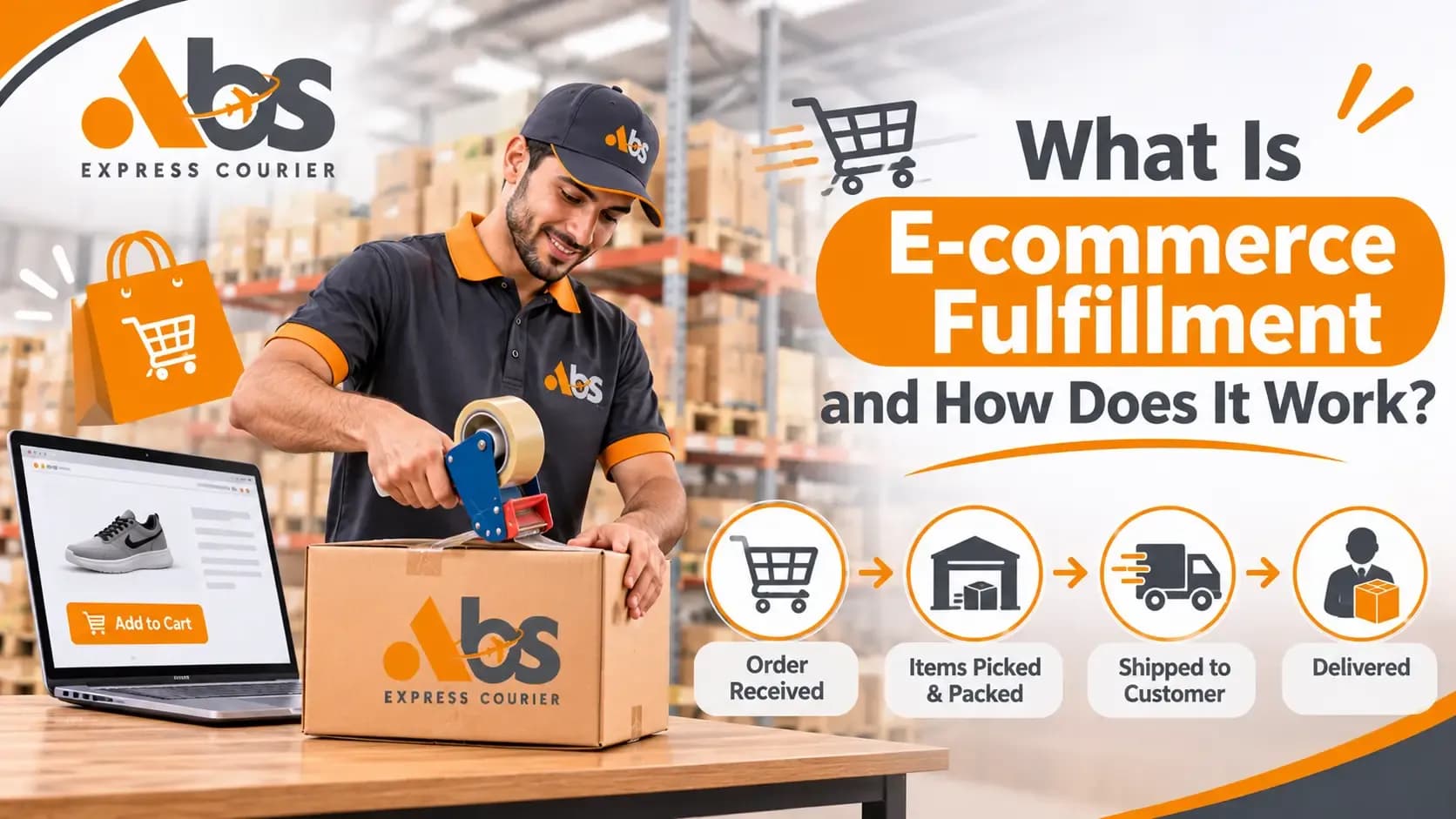
E-commerce fulfillment is everything that happens between the moment stock reaches your hands and the moment a customer's order, or return, is closed. It covers storage, order preparation, packaging, shipping and returns handling.
It determines whether customers receive the right product in good condition, as promised by your store. Most buyers judge a shop by this experience, not by its website.
The process runs through five stages: receiving and storage, order processing, picking and packing, shipping and delivery, and returns. If you run an online store in Egypt, you will learn how each step works, how in-house and outsourced fulfillment compare, and which questions to ask when choosing a provider.
What Is E-commerce Fulfillment?
E-commerce fulfillment is every operational activity that completes an online order: receiving and storing inventory, preparing and packing items, shipping them, and handling returns. An e-commerce fulfillment center is the facility where this happens, supported by warehouse management software.
Three terms are often confused:
Warehousing: storing goods until needed.
Shipping: moving a parcel from seller to customer.
Order fulfillment: picking, packing and dispatching each order.
For example, when a Cairo store sells a shirt, staff pick it, pack it, and hand it to a courier. Stores that do not want to manage this work themselves can use third-party fulfillment services to handle it.
How Does the E-commerce Fulfillment Process Work?
The e-commerce fulfillment process is the chain of steps that moves a product from a shelf to a customer's door, and back again if it is returned. Here is how order fulfillment works, using a small Egyptian online store as the example.
Imagine a store that sells phone accessories and receives one cash-on-delivery order for a single charger. The order follows these order fulfillment process steps:
The charger is already stored, because stock was received and recorded earlier.
The order is confirmed and released for preparation.
A worker picks the charger and packs it.
A courier collects the parcel, delivers it and collects the cash.
If the customer returns it, the charger comes back for inspection.
Receiving and Storing Inventory
Fulfillment starts when stock arrives from the supplier. Staff check quantities and SKU codes (the unique code for each product) against the receiving order and flag any damage.
Items are then recorded in a warehouse management system (WMS), software that tracks where each product sits. Fast sellers can be placed near the packing station.
Accurate stock data across every sales channel is the core of inventory management for e-commerce. It prevents you from selling products you no longer have. Procedures differ between providers.
Processing Incoming Customer Orders
When the charger is ordered, the store platform records it and passes it to the provider or to an order management system (OMS). The OMS confirms availability, chooses the fulfillment location and releases the order to the warehouse. Some businesses do this manually. Rules such as FIFO (first in, first out) or FEFO (first expired, first out) keep stock rotation accurate.
Picking and Packing Products
Picking means collecting ordered items from their storage spots. A worker receives SKU codes, quantities and locations, and may work in batches, zones or waves.
Packing means preparing the items for transport. They are checked, sealed securely in the smallest practical package, and labelled.
Good packing protects goods, lowers shipping costs, and reduces returns caused by damage or mistakes.
Shipping Orders to Customers
Shipping starts when the packed order is handed to the chosen courier, which generates a tracking number and notifies the customer. Last-mile delivery is the final leg from the courier network to the customer's door.
Choose a courier by weighing speed, cost, destination, parcel size and service level. Coverage and tracking depend on the provider. For cash-on-delivery orders in Egypt, the courier also collects payment. Express courier services are one option to compare.
Managing Returns and Exchanges
Reverse logistics is the movement of goods back from the customer to the seller for inspection. Sellable items return to stock, while others are recycled or discarded. The refund or exchange follows the seller's policy. Recurring return reasons, such as the wrong item, wrong size, or transit damage, point to problems in fulfillment or supply.
What Services Are Included in E-commerce Fulfillment?
E-commerce fulfillment services cover everything between a product arriving in storage and the customer receiving it. The range differs between companies: some offer a complete solution, while others handle only specific logistics activities.
Some providers also add services such as custom packaging, relabeling or customer updates. Confirm what is included before you sign.
Warehousing and Inventory Management
Warehousing gives your products a place to wait before orders arrive. Items are stored by size, turnover, and handling needs, with stock ideally tracked in real time. Too much stock ties up cash, while too little leads to lost sales, so setting a reorder point helps.
Order Processing and Packaging
Once an order is released, staff pick the items, scan them to confirm they are correct, and pack them. Accuracy matters here, and packaging options, including branded or protective packaging, should be verified with the provider.
Shipping and Last-Mile Delivery
After packing, the parcel is handed to a courier with a label and tracking number, and the customer is notified. A provider may deliver directly or coordinate with courier partners. Costs depend on distance, parcel type, and speed.
Returns Management and Reverse Logistics
Some providers also handle returns, which is known as reverse logistics: moving a product back from the customer to the seller. When a customer sends an item back, the provider receives it and inspects it. If it is in sellable condition, it goes back into stock. If not, it may be recycled or disposed of. Policies and responsibilities vary between providers, so agree in your contract who inspects items, who decides on refunds or exchanges, and how restocked units are recorded.
What Are the Benefits of Outsourcing E-commerce Fulfillment?
Outsourcing means handing storage, packing and shipping to a third-party logistics (3PL) provider, a specialist company. Done well, it can bring:
less daily workload and more time for sales
better-organized inventory
room to scale during demand peaks
lower upfront investment in space and staff
Outsourced order fulfillment does not automatically cut costs or speed up delivery. Results depend on the partner you choose.
In-House vs. Outsourced E-commerce Fulfillment: What Is the Difference?
In-house fulfillment means you store, pack and ship orders yourself; outsourcing hands some or all of that to a provider. The in-house vs outsourced fulfillment choice depends on your order volume.
Factor
In-house
Outsourced
Costs
Space, equipment, packaging, staff
Service, storage and handling fees
Control
Direct, daily
Needs clear agreements
Storage and staffing
Your own
Provider's
Delivery
Your courier arrangements
Provider coordinates
Scalability
Harder as you grow
Easier for peaks
In-house suits small shops with few orders; outsourcing suits growing volume.
How Do You Choose the Right E-commerce Fulfillment Partner?
Choose a partner by checking its full service scope, not just its price. Providers differ, so use the questions below as a checklist when comparing fulfillment services in Egypt.
Ask each provider to answer in writing before you sign. A verbal promise about storage, coverage or returns is hard to enforce later.
Storage Capacity and Inventory Management
Storage is the foundation of the service, so test how your stock will actually be treated.
Ask how stock is received, counted, located and reported, and whether the storage suits your product types.
Ask how fragile or special items are handled, and how the provider copes with seasonal peaks.
Shipping Coverage and Delivery Options
Coverage must match the places your customers really order from.
Confirm which governorates are covered; never assume nationwide coverage.
Ask about the couriers used, the delivery options and how cash-on-delivery payments are handled.
Technology and Order Tracking
Good information lets you answer customers without calling the provider.
Ask about real-time tracking, live stock visibility and whether the system connects to your sales platform, and get each answer confirmed in the agreement.
Pricing and Service Flexibility
Pricing structures differ, so compare them line by line against your own order volume and product size.
Request a transparent breakdown: inbound shipping, storage, picking and packing, outbound shipping, returns and support.
Check flexibility for peaks, special packaging and contract terms.
Returns Handling and Customer Support
Returns are where unclear responsibilities cause the most friction.
Understand the return policy and how customers send items back, including inspection and restocking.
Ask who handles customer queries, how problems are escalated and how order status is communicated.
How Does ABS Courier Support E-commerce Fulfillment in Egypt?
ABS Courier, a courier and freight company offering fulfillment services in Egypt and related logistics, provides local and international express delivery, logistics services covering storage to distribution, packing services and express courier shipping, plus shipment tracking and a cost calculator.
Confirm picking, inventory management and platform integration directly: call 16231, email info@absegy.com or contact ABS to discuss your requirements.
Frequently Asked Questions About E-commerce Fulfillment
What Is the Difference Between E-commerce Fulfillment and Shipping?
Shipping is one step; fulfillment is the whole operation around it. Shipping moves a parcel from the seller to the customer through a carrier. E-commerce fulfillment also covers receiving and storing stock, processing orders, picking, packing and handling returns, so shipping is the stage that starts only after the order is ready.
Is E-commerce Fulfillment Suitable for Small Businesses?
Yes, but the right model depends on order volume. Many small sellers and new stores start by fulfilling orders themselves, because it gives full control and needs little setup. Outsourcing becomes worth considering when packing and dispatching take time away from sourcing, marketing and customer service, or when growth strains your space.
How Much Does E-commerce Fulfillment Cost?
The cost depends on the provider and your products, so no single figure applies. Common charges include sending stock to the fulfillment center, storage fees based on size and duration, picking and packing fees, delivery fees based on weight, size, distance and speed, and returns handling. Ask each provider for a full, itemized quotation.
What Is the Difference Between In-House and Third-Party Fulfillment?
In-house means you store, pack and ship orders yourself; third-party means a specialist company, known as a 3PL, does some or all of it for you. The first gives direct control but needs space, staff and materials. The second reduces your workload but gives you less direct oversight of daily operations.
How Does a Fulfillment Center Manage Inventory?
A fulfillment center records every delivery in a warehouse management system and tracks each item by its SKU, the unique product code. Incoming goods are checked against the receiving order and for damage, then placed in assigned locations. Fast-selling items are often stored closest to packing, and stock counts are updated as orders leave.
Can E-commerce Fulfillment Providers Handle Product Returns?
Many can, but not all of them include returns in their service. Where they do, the item goes back to the warehouse and is inspected. Sellable items return to stock, while damaged ones may be recycled or discarded. Before signing, ask how returns are collected, inspected and reported to you.
When Should an Online Business Outsource Its Fulfillment Operations?
Consider outsourcing when order handling limits your growth rather than supports it. Typical signs are a storage area that is full, packing errors, delays during busy periods, or an owner spending most of the day on dispatch. Compare providers on coverage, technology and pricing transparency first, since outsourcing does not automatically lower costs or speed up delivery.
Plan Your Fulfillment Setup with Clear Questions
E-commerce fulfillment covers everything between receiving stock and handling a return, so the best setup is the one that matches your order volume, product type and delivery areas. Before choosing in-house or outsourced operations, write down what you need for storage, packing, shipping and returns.
Then ask each provider, in writing, which of those steps it handles itself and which it coordinates with partners. To discuss your logistics and fulfillment requirements and confirm which services fit your store, contact ABS Courier at 16231 or info@absegy.com.